Chairs are among the most frequently repeated design elements at a wedding reception. A centerpiece may appear once on each table, while a chair profile may be repeated dozens or even hundreds of times throughout the room. That repetition gives seating a significant influence over the reception’s overall appearance.
Cane and cross-back chairs can both complement Charleston weddings, but they create distinctly different visual effects. Cane introduces woven texture and a more continuous back surface. Cross-back chairs create open geometry and a clearly repeated X-shaped pattern. Their effect depends not only on the individual chair but also on the table shape, venue background, floor plan, and other natural textures used throughout the design.
Rather than treating one style as elegant and the other as rustic, couples and planners should evaluate how each chair will look when repeated across the entire reception. The right selection is the one that supports the table design, maintains comfortable spacing, and contributes the appropriate amount of visual structure.
Evaluate the Chair Back as a Repeating Pattern
An individual chair may appear subtle when viewed in a showroom or product image. Once the same profile surrounds every reception table, however, the chair backs form a pattern that can become one of the room’s strongest visual features.
The first comparison between cane and cross-back chairs should therefore focus on repetition rather than labels such as traditional, casual, or formal.
Understand the Softer Texture of Cane
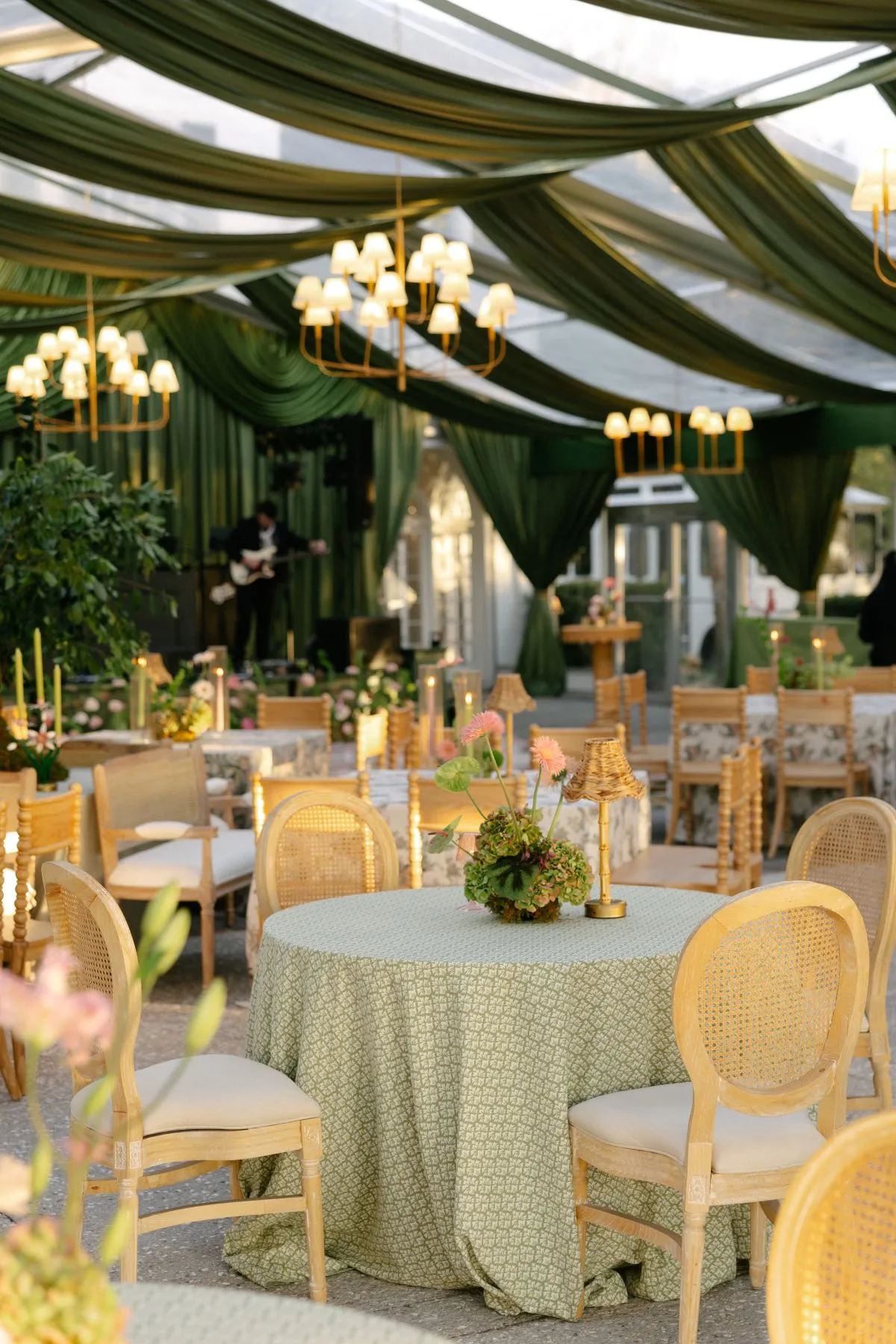
Cane-backed chairs introduce a woven surface that fills more of the space within the chair frame. The material can bring texture to the reception without depending on a strong color or decorative pattern.
Depending on the chair’s shape, cane may:
-
Add visual warmth to a neutral room
-
Soften a formal table setting
-
Create a more furnished or residential quality
-
Introduce texture against a solid linen
-
Remain noticeable in close photography
Add visual warmth to a neutral room
Soften a formal table setting
Create a more furnished or residential quality
Introduce texture against a solid linen
Remain noticeable in close photography
Not every cane chair produces the same effect. A Louis-style cane chair can feel more traditional and structured, while a folding or café-style cane chair may appear lighter and less formal. The frame, back shape, finish, and seat all influence the final impression.
For this reason, “cane chair” should not be treated as one standard design category. The specific chair profile matters as much as the woven material.
Recognize the Strong Geometry of Cross-Back Chairs
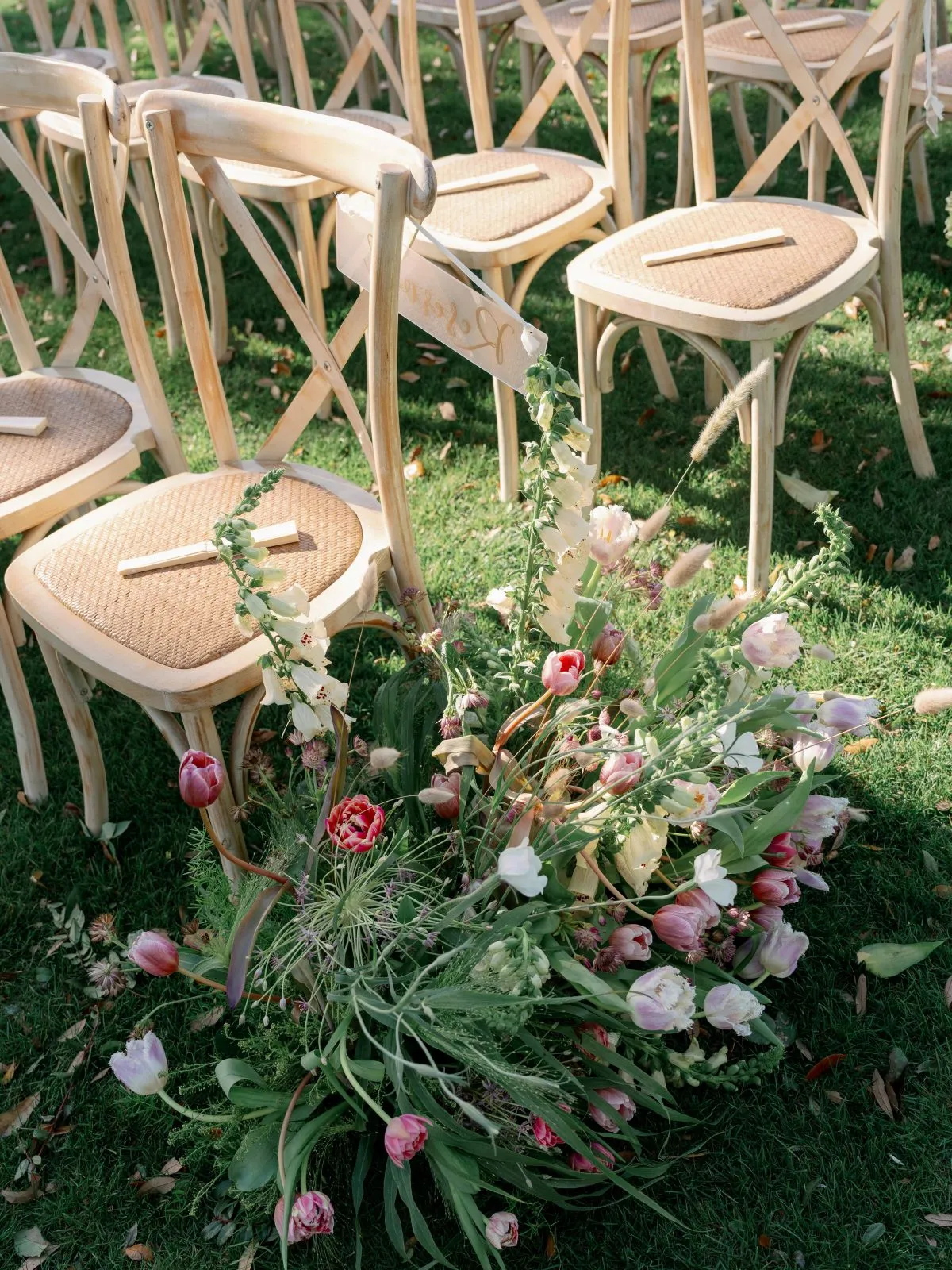
A cross-back chair creates a more open back with a clearly visible X-shaped frame. When repeated along a table, that geometry establishes a strong and recognizable visual rhythm.
Cross-back chairs can:
-
Reinforce the length of banquet and farm tables
-
Add definition to a neutral tent or dining room
-
Allow the venue background to remain visible through the frame
-
Create a clear pattern without relying on fabric or ornament
-
Provide contrast against soft linens and rounded tabletop pieces
Reinforce the length of banquet and farm tables
Add definition to a neutral tent or dining room
Allow the venue background to remain visible through the frame
Create a clear pattern without relying on fabric or ornament
Provide contrast against soft linens and rounded tabletop pieces
Although cross-back seating is frequently associated with rustic weddings, the chair does not automatically create a casual result. A polished tablescape, tailored linen, refined china, and controlled color palette can shift the same chair toward a more elevated setting.
The surrounding design determines whether the cross-back pattern feels relaxed, traditional, or contemporary.
Review a Group of Chairs, Not One Sample
A chair should be evaluated as part of a repeated arrangement.
Position several chairs around the proposed table and examine the setup from the side, end, and across the room. This reveals whether the chair backs form a balanced pattern or introduce more visual density than expected.
A distinctive cane chair may appear prominent in a close-up image but become balanced when repeated around linen-covered tables. A cross-back chair that seems understated individually may create a much stronger graphic pattern when used across the full reception.
Testing more than one chair helps show the effect guests will actually experience.
Choose the Profile Based on What Guests Will See Behind It
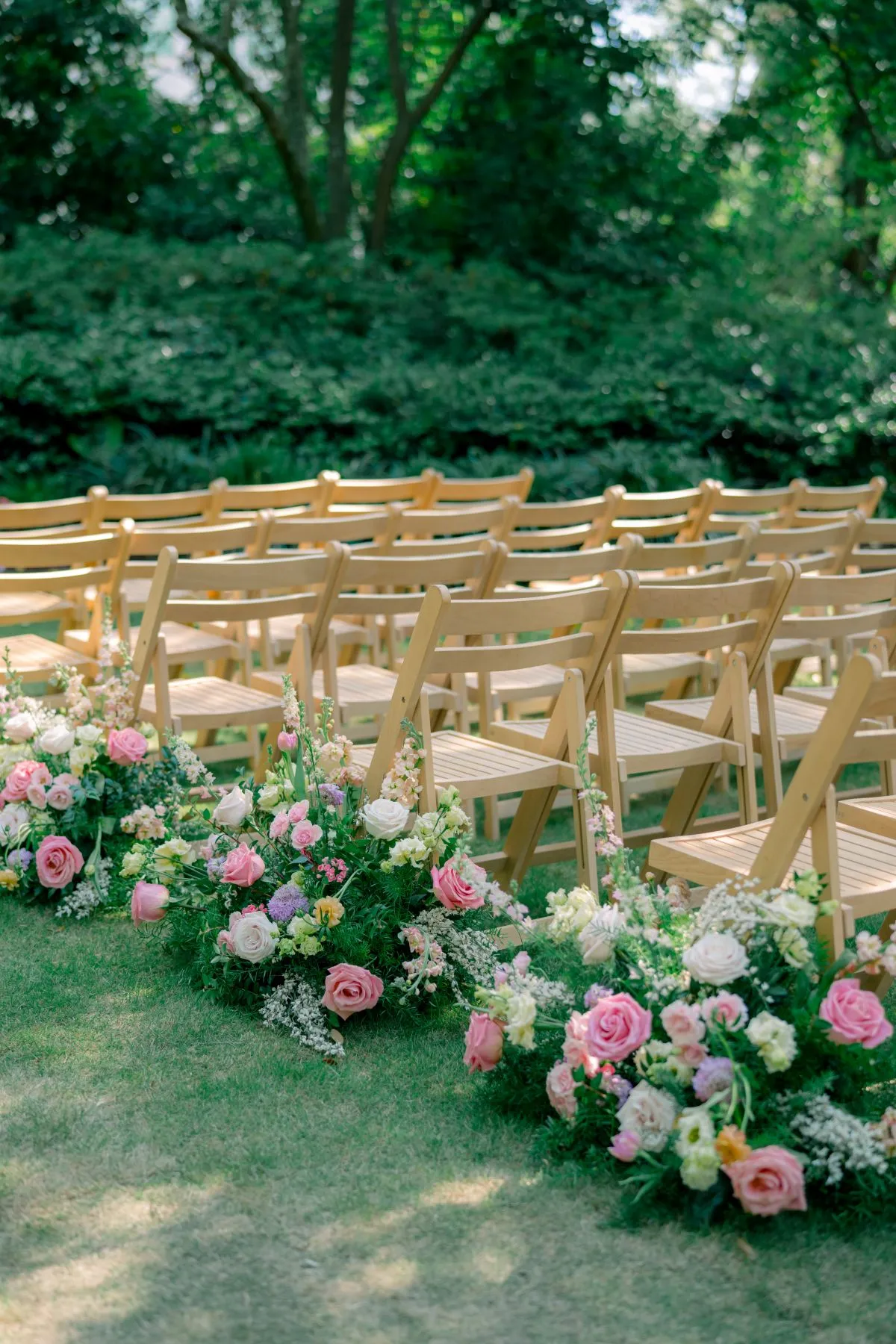
The background surrounding the chair affects how prominent its shape and texture will appear. A chair that looks balanced against a simple tent sidewall may compete with a garden, brick wall, patterned linen, or detailed historic interior. The venue should therefore be considered as part of the chair selection.
Consider Visually Detailed Venue Backgrounds
Charleston wedding venues may include gardens, ironwork, exposed brick, historic architecture, trees, or waterfront views. These features already provide substantial visual detail.
A cane chair adds another layer of texture in front of that setting. This can create warmth and depth, but a heavily woven or decorative chair may also compete with an intricate background.
An open cross-back frame allows more of the venue to remain visible, although its repeated X-shaped pattern can still become prominent when viewed across several tables.
There is no universal rule that one style works better in historic or outdoor spaces. The chair should be tested against the specific view that guests will see.
Add Definition to Neutral Tent Interiors
A light or neutrally lined tent provides a different design challenge. Because the background is relatively uniform, the furniture may need to create more of the room’s visible structure.
Cane chairs can introduce controlled texture against a smooth tent interior. Cross-back chairs can create a stronger repeated pattern that defines the dining area.
The choice depends on what the rest of the room needs. A tent with detailed linens, chandeliers, or a layered tabletop may benefit from the softer texture of cane. A restrained tent design may need the stronger geometry of a cross-back profile.
Create Separation Through Finish
A chair can lose its visual definition when its finish is too similar to the flooring, tables, tent walls, or surrounding furniture.
Separation can be created through:
-
A lighter or deeper wood tone
-
A painted or washed frame
-
Contrast between woven and smooth surfaces
-
A visible seat pad
-
A warmer or cooler finish
A lighter or deeper wood tone
A painted or washed frame
Contrast between woven and smooth surfaces
A visible seat pad
A warmer or cooler finish
The chair does not need to match every wood tone in the reception. Slight variation can keep the furniture from blending into one indistinct field of brown, beige, or neutral color.
Decide Whether the Table or Chair Carries the Natural Texture
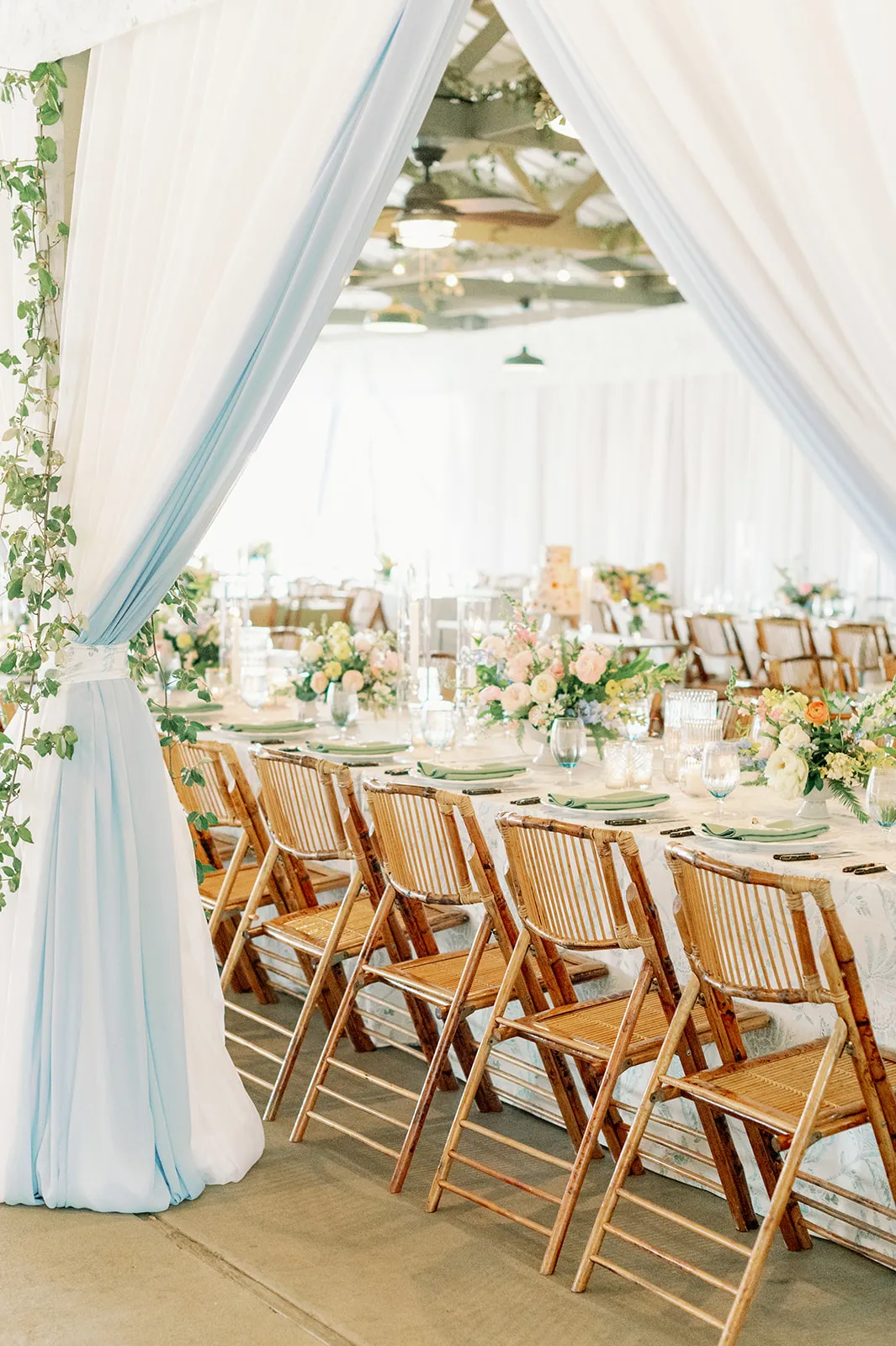
Cane, exposed wood tables, cross-back frames, woven chargers, textured linens, and natural accessories can all contribute organic character. When all of these elements are used with equal strength, the room can become overly themed. Decide which element will provide the dominant natural texture and allow the others to play supporting roles.
Balance Chairs With Exposed Wood Tables
An exposed wood table already contributes grain, tone, and material texture.
Pairing it with cross-back chairs creates a strong combination of repeated wood and geometry. This can work effectively when the design calls for a clearly defined natural foundation, but it should be a deliberate decision rather than an automatic formula for rustic elegance.
Cane chairs may create a softer relationship with the table, but they also introduce another natural surface. A heavily textured cane back can compete with pronounced wood grain if both elements receive equal visual emphasis.
Review whether the table or the chairs should carry more of the natural-material statement. The other element can then be selected in a quieter finish or profile.
Use Linen-Covered Tables as a Cleaner Background
A full linen conceals the structure and surface of the table, causing the chair back to become one of the most visible furniture elements in the room.
Against a solid linen, a cane chair can introduce texture without requiring an additional pattern. A cross-back chair can add structure and rhythm along the table perimeter.
The linen color also affects the chair’s visibility. A natural wood chair may stand out clearly against an ivory or pale linen but appear less distinct against taupe or brown. A darker frame can create stronger contrast against a light table covering.
The purpose is not to match the chair to the linen exactly. It is to ensure the two elements are visually balanced.
Avoid Repeating the Same Natural Cue Everywhere
When the chairs already provide visible wood, woven cane, or open rustic geometry, other natural textures should be introduced carefully.
The design may not also need:
-
Woven chargers
-
Wood centerpiece bases
-
Burlap runners
-
Rattan accessories
-
Multiple unfinished wood tones
-
Heavy greenery attached to chairs
Woven chargers
Wood centerpiece bases
Burlap runners
Rattan accessories
Multiple unfinished wood tones
Heavy greenery attached to chairs
One or two natural materials can establish warmth without turning the entire reception into a literal interpretation of a rustic theme.
Match the Chair Profile to the Table Shape
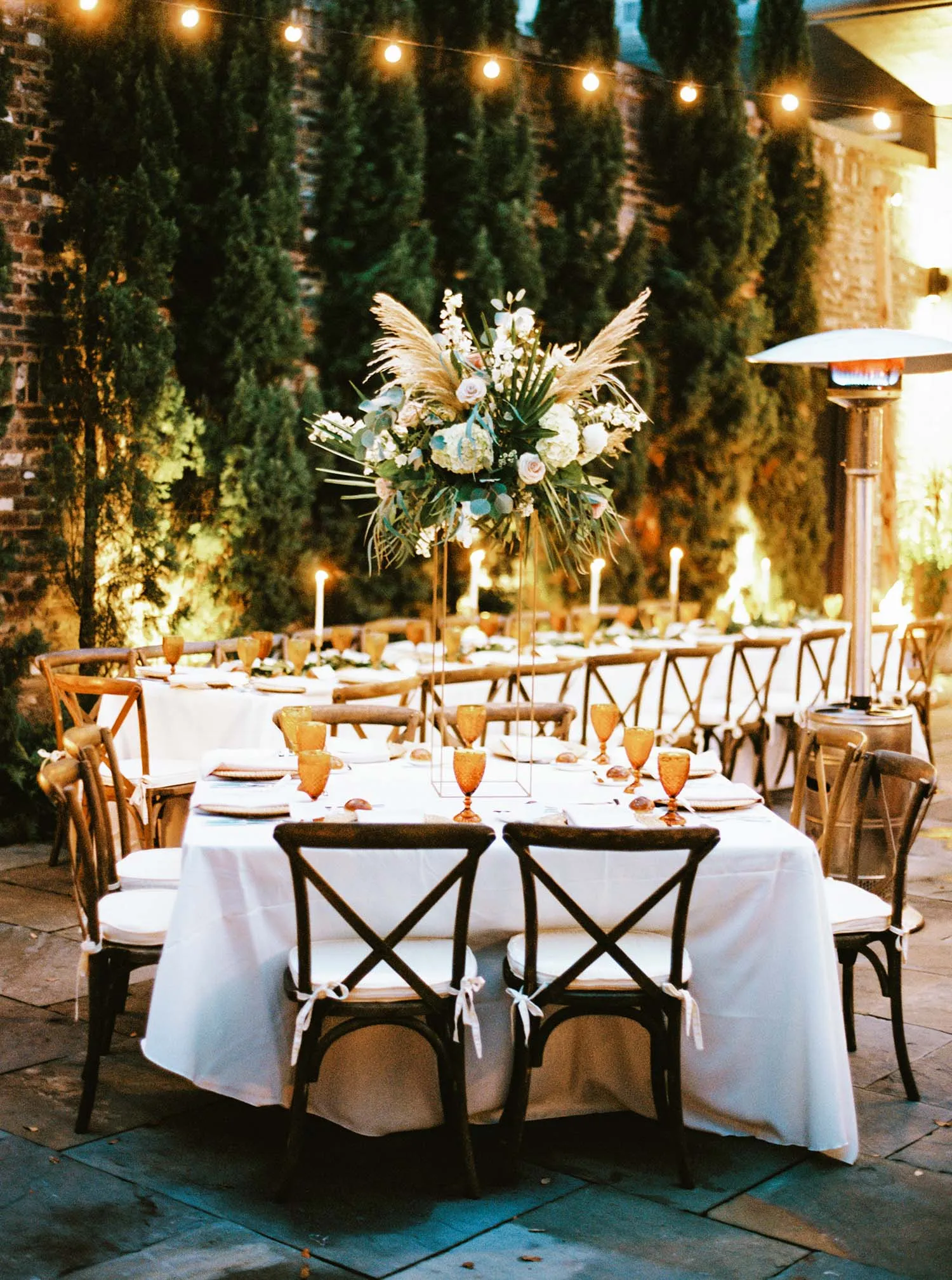
The chair becomes part of the table’s visible perimeter. Long tables produce lines of repeated chair backs, while round tables create a complete ring around the tabletop.
The effect of cane and cross-back seating should be considered in relation to the table shape rather than evaluated separately.
Create Rhythm Along Long Tables
At a long banquet or farm table, chairs form repeated lines along both sides.
Cross-back chairs emphasize the table’s length through a sequence of X-shaped frames. This can give the arrangement a clear structure, particularly when viewed from the end of the table.
Cane-backed chairs create a more continuous band of texture. Their woven surfaces may soften the strong horizontal form of the table and make the dining area feel more furnished.
Review long tables from multiple directions. A chair pattern that appears balanced from the side may feel visually dense when viewed from the end or from the reception entrance.
Control the Perimeter Around Round Tables
Around a round table, chair backs form a visible ring.
Wider or more solid cane profiles can create a fuller perimeter, especially when the chairs are placed close together. Open cross-back chairs may provide more visual space between guests and allow the linen or venue background to remain visible.
The result depends on:
-
Chair width
-
Table diameter
-
Number of guests
-
Linen fullness
-
Distance between neighboring tables
-
Space behind occupied chairs
Chair width
Table diameter
Number of guests
Linen fullness
Distance between neighboring tables
Space behind occupied chairs
A round-table mockup should use the planned guest count. Removing one or two chairs during testing can significantly change the visual and functional balance.
Keep Mixed Table Shapes Visually Connected
Many receptions combine round dining tables with rectangular family tables, banquet tables, or a separate couple’s table.
Using one chair profile throughout can connect those different formats. The repeated seating creates consistency even when the table shapes change.
When two chair styles are necessary, they should share a clear relationship through wood tone, frame finish, seat color, or level of formality. The change should look intentional rather than like an unrelated substitution.
Use Exact Chair Dimensions in the Floor Plan
Cane and cross-back describe visual styles, not standard measurements. Two chairs within the same category may differ substantially in width, depth, and back height.
The floor plan should always use the dimensions of the exact rental product.
Curated Events Charleston carries several cane and cross-back formats, including the Fritz Cane Folding Chair, Louis Cane Back Natural, Quay Cane Café Dining Chair, Criss Cross Chair, and Tuscan Brown Chair. Each profile occupies a different amount of space and creates a different visual effect.
Calculate Spacing Using the Selected Product
Do not plan table capacity using a generic chair allowance.
The exact chair dimensions affect:
-
The number of chairs that fit around the table
-
Space between neighboring chair backs
-
Alignment with individual place settings
-
Clearance between tables
-
Service routes
-
Guest circulation
The number of chairs that fit around the table
Space between neighboring chair backs
Alignment with individual place settings
Clearance between tables
Service routes
Guest circulation
A wider cane chair may require fewer seats around a round table than a narrower cross-back model. Reducing the gap between chairs to maintain the same guest count can compromise comfort and make the room appear crowded.
Test Chairs in Tucked and Occupied Positions
Floor plans often show chairs neatly tucked beneath the table, but occupied chairs extend farther into the room.
Review the layout with the chair:
-
Tucked beneath the table
-
Pulled out for seating
-
Occupied by a guest
-
Positioned beside another occupied chair
Tucked beneath the table
Pulled out for seating
Occupied by a guest
Positioned beside another occupied chair
This is especially important near:
-
Tent poles
-
Walls
-
Bars
-
Service stations
-
Main aisles
-
Neighboring tables
Tent poles
Walls
Bars
Service stations
Main aisles
Neighboring tables
A layout that appears spacious with empty chairs may become restrictive once guests are seated.
Review Back Height Against the Full Table
Chair-back height affects how much of the room, table, and centerpiece remains visible.
A taller or more decorative cane chair may become prominent in room-level photographs. A lower or more open cross-back profile may allow the tabletop and venue background to receive more attention.
Review the chair in relation to:
-
Table height
-
Linen drop
-
Centerpiece height
-
Place-setting scale
-
Nearby furniture
-
The primary viewing angle
Table height
Linen drop
Centerpiece height
Place-setting scale
Nearby furniture
The primary viewing angle
The correct height is not simply a matter of visibility. It determines how the table and seating divide visual attention.
Decide Whether One or Both Chair Styles Belong in the Design
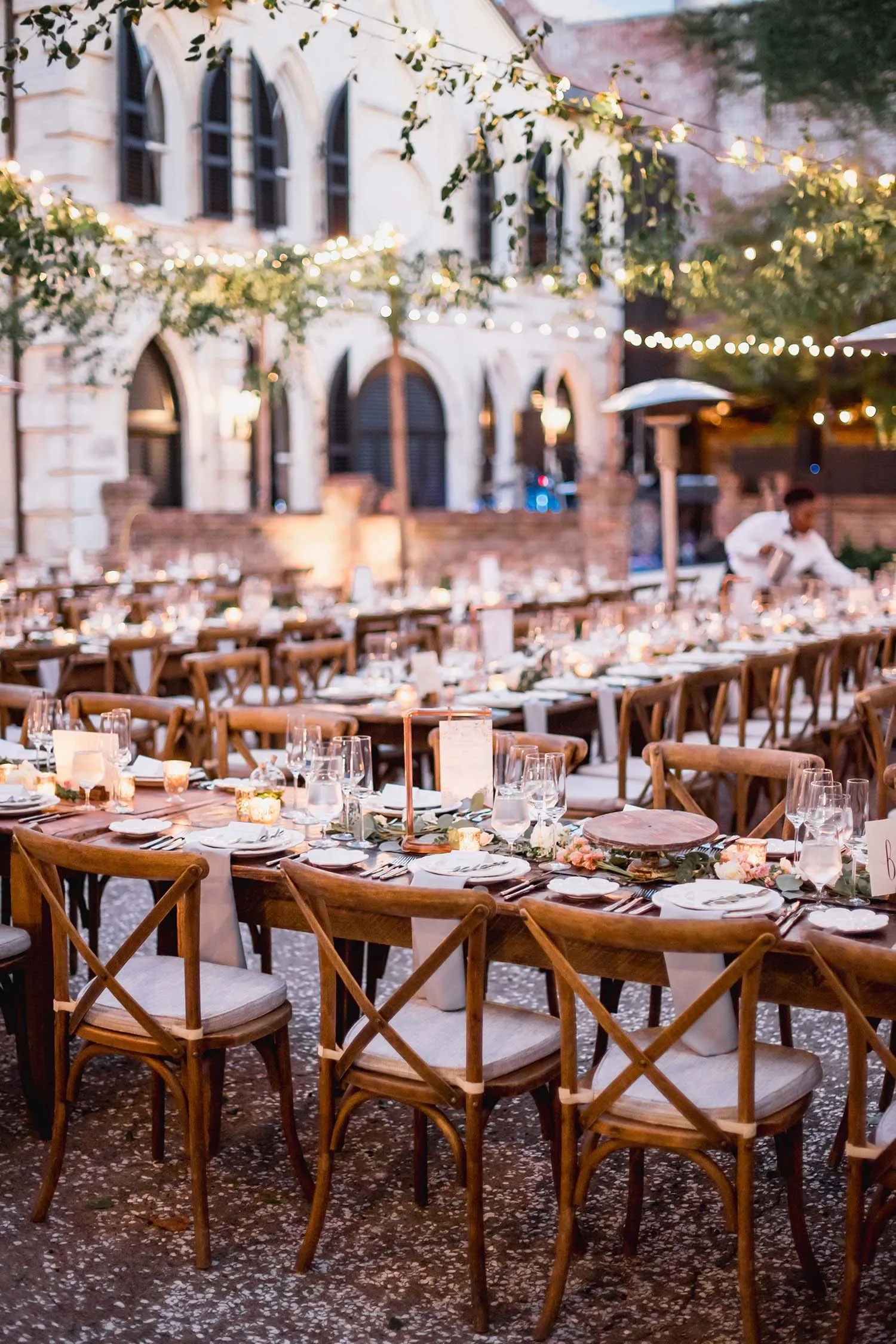
Cane and cross-back chairs can appear within the same wedding, but each style should have a defined role.
Mixing them simply to introduce variety can make the reception feel inconsistent. The change should communicate function, hierarchy, or a clear transition between event spaces.
Use One Style as the Primary Guest Chair
Selecting one primary chair for reception dining creates a consistent visual field.
This approach can be particularly effective when:
-
Multiple table shapes are used
-
The venue already contains substantial architectural detail
-
Linens or china introduce strong patterns
-
The room needs a calm foundation
-
The floor plan includes several connected dining zones
Multiple table shapes are used
The venue already contains substantial architectural detail
Linens or china introduce strong patterns
The room needs a calm foundation
The floor plan includes several connected dining zones
Repeating one chair allows the other design elements to vary without making the reception feel fragmented.
Give the Second Style a Specific Purpose
A second chair style may be reserved for:
-
The couple’s table
-
A small family table
-
Ceremony seating
-
A separate dining zone
-
Another clearly defined event space
The couple’s table
A small family table
Ceremony seating
A separate dining zone
Another clearly defined event space
For example, a more decorative cane chair could distinguish the couple’s table while cross-back chairs remain the primary guest seating. The difference should be visible enough to appear deliberate but connected enough to belong within the same event.
Establish a Shared Visual Link
When both chair profiles are used, connect them through at least one feature.
That connection may be:
-
A similar wood tone
-
A comparable seat color
-
A related frame finish
-
Similar visual weight
-
A shared level of formality
A similar wood tone
A comparable seat color
A related frame finish
Similar visual weight
A shared level of formality
Avoid adding excessive fabric, florals, or accessories solely to force two unrelated chairs to coordinate. The relationship should come primarily from the furniture itself.
Preserve the Features That Made the Chair Distinctive
Cane and cross-back chairs are selected for their prominent backs. Heavy decoration can conceal the exact feature that made the chair appealing. Styling should support the chair rather than disguise it.
Keep the Back Profile Visible
Avoid covering the cane weave or X-shaped frame with:
-
Broad fabric panels
-
Large sashes
-
Oversized floral arrangements
-
Full chair covers
-
Dense greenery
-
Signs attached to every chair
Broad fabric panels
Large sashes
Oversized floral arrangements
Full chair covers
Dense greenery
Signs attached to every chair
A small detail may be appropriate for aisle chairs, the couple’s seats, or another limited feature area. Repeating elaborate decorations across every reception chair can overwhelm the room and obscure the furniture.
Use Seat Details With Restraint
A seat pad may introduce comfort, contrast, or a controlled amount of color, depending on the specific rental chair and available options.
Review whether the seat:
-
Coordinates with the table linen
-
Adds useful contrast
-
Makes the chair appear visually heavier
-
Changes the desired level of formality
-
Distracts from the back profile
Coordinates with the table linen
Adds useful contrast
Makes the chair appear visually heavier
Changes the desired level of formality
Distracts from the back profile
Do not assume that every cushion or fabric can be applied to every chair. The available chair configuration should guide the decision.
Repeat Only One Supporting Cue
The chair can be connected to the tablescape through one controlled detail, such as:
-
A related wood tone
-
A linen color
-
A warm or cool finish
-
A subtle woven accent
-
A repeated curve or geometric line
A related wood tone
A linen color
A warm or cool finish
A subtle woven accent
A repeated curve or geometric line
The chair does not need to match the linen, tableware, florals, bar, and lounge furniture simultaneously. A limited connection often produces a more refined result.
Chair-Profile Mistakes to Catch Before the Wedding
Most chair-selection problems occur when the furniture is evaluated as an individual object rather than a repeated part of the room.
Choosing From a Close-Up Product Image
A woven cane back or X-shaped frame may look subtle online but become one of the strongest patterns in the reception when repeated many times. Always review the selection at table and room scale.
Assuming Cane Is Always Formal and Cross-Back Is Always Rustic
The final effect depends on the specific chair silhouette, frame finish, table treatment, venue, and surrounding rentals.
A Louis-style cane chair may feel traditional, while a folding cane chair can appear relaxed. A cross-back chair can support a polished reception when paired with refined tabletop pieces and tailored linens.
Ignoring Chair Width When Finalizing Table Capacity
Chair widths vary, even within the same general style category. Using generic measurements can result in crowded tables, reduced circulation, or a last-minute change in guest capacity. The exact product dimensions should be incorporated into the layout from the beginning.
Adding Too Many Natural Materials
Exposed wood tables, cane chairs, woven chargers, burlap, rattan, and natural centerpiece bases can overwhelm one another when used together. Choose one or two elements to carry the strongest natural texture and allow the remaining pieces to provide contrast.
Frequently Asked Questions
Are cane chairs more formal than cross-back chairs?
Not automatically. Some cane chairs have traditional or formal silhouettes, while others feel lighter and more relaxed. The chair shape, finish, table, and surrounding rentals determine the final level of formality.
Do cross-back chairs only work with farm tables?
No. Cross-back chairs can be used with exposed wood tables or linen-covered tables. Their graphic profile should be evaluated in relation to the table shape, linen, venue, and overall design.
Can cane and cross-back chairs be used at the same wedding?
Yes, when each chair has a defined purpose. One style may serve as the main guest chair while the other is reserved for the couple’s table, ceremony, or another separate zone.
Should wedding chairs match the table finish?
Exact matching is not required. A controlled difference in tone or texture can prevent the furniture from blending into one uniform block. The finishes should relate without appearing identical.
Which chair works better around a round table?
The better option depends on the dimensions of the exact chair, table diameter, guest count, linen volume, and desired visual density. A full mockup is more reliable than selecting according to the style name alone.
Choose the Pattern the Entire Room Will Repeat
The decision between cane and cross-back chairs is not simply a choice between an elegant style and a rustic one. Each profile creates a different repeated pattern, occupies a different amount of space, and interacts differently with the venue and tables.
Cane can introduce woven texture and soften a reception design. Cross-back chairs can provide open geometry and stronger visual rhythm. The right choice depends on the venue background, table shape, surface treatment, exact chair dimensions, and the amount of natural texture already present in the room.
Curated Events Charleston offers multiple cane, cross-back, folding, and specialty chair profiles that can be compared alongside the planned tables, linens, floor plan, and venue setting. Evaluating the chair as part of the complete reception—not as an isolated product—can help create seating that looks intentional from every important angle.
